By definition, Leftists want the government to control much of their money and lives. Governments are run by politicians, which have a favorability rating around 15–20%. Who wants them to control the economy or our lives?
If you do, look around at the numerous countries that have tried this. They invariably get corrupt and their people become poor.
I’m not against programs that give money to parents to educate their children as they see fit. I’m also not against programs that give money to each of us to provide for medical expenses. But this money should go to all equally so that we have ‘equal rights before the law’.
If structured properly, these programs don’t allow Congress to control our lives because parents would be able to choose the school for their children.
And adults could choose their doctors and hospitals for them and their children.
Leftists such as United States Senator Elizabeth Warren, “Unveiled a proposal (in February 2019) outlining the Universal Child Care and Early Learning Act, a comprehensive plan to provide millions of families with free, high-quality child care and early learning options and to ensure that every family in the country can affordably access these services.”
Notice the use of the word ’free’. Leftists love to use that word. ‘Free’ means to them, “Paid for by you from a tax or deficit increase”.
What about if a family would like the mother to stay home and raise their children? Would they get the equivalent amount as a child-care subsidy? Nope. Their taxes would go up making it harder for mothers to raise their children without having to work for money. Is this really what we want?
Senator Elizabeth Warren also wants to break up companies such as Google, Amazon and Facebook, because they are too big and dominate the markets. That’s all we need is some politicians deciding what companies are “too big” and how to control them.
It gets worse.
Newly elected United States Rep. Alexandria Ocasio-Cortez, (nicknamed AOC), said, “The world is going to end in 12 years if we don't address climate change”.
OMG. Current projections are that the atmosphere will increase in temperature by an average of about 0.2 degrees Celsius in 12 years. I’ll take bets of any amount about the world ending in 12 years.
Later she said, “Our planet is going to hit disaster if we don’t turn this ship around, and so it’s basically like, there’s a scientific consensus that the lives of children are going to be very difficult. And it does lead, I think, young people to have a legitimate question, you know, ‘Is it okay to still have children?'”
Great. Let’s stop having children. Then maybe the Earth can ‘heal itself’. But I do think that people who actually believe AOC should not propagate.
Please save us all from Leftists. I beg of you.
Tim Farage is a Professor and Graduate Advisor in the Computer Science Department at The University of Texas at Dallas. He writes about mathematics, computer science, physics, chemistry, the reconciliation between science and spirituality, Intelligent Design, and the application of Natural Law to our various systems such as education, government and economics.
Showing posts with label Environmentalism. Show all posts
Showing posts with label Environmentalism. Show all posts
Saturday, March 9, 2019


Sunday, October 23, 2016
How can we save the Earth?
The
Earth doesn’t need saving. What can hurt the Earth? The Sun can. In a
few billion years, the Sun will destroy the Earth. We can start worrying
about that in a million years or so. A huge asteroid, say 1000 miles in
diameter, could destroy the Earth. Not much we can do about that, so
there’s no reason to worry about it.
What about
saving life on Earth? Life has existed on Earth for well over 3 billion
years. It has survived ice ages, large asteroids, diseases, and
everything else that’s been thrown at it – for 3 thousand million years.
At present, life exists on land, under the land, in the oceans, and in
the air. Life on Earth is not likely to die off until the Sun does it
in.
Certainly, some species will go extinct,
and some new ones will crop up. This is as it always has been. Over 99%
of the species that ever existed are now extinct. This is how nature
works. Don’t feel bad: no species cares if they go extinct, except for
humans.
So “saving the Earth” mostly means
“saving humans”. Well, there’s good news about humans. There are human
communities on every continent except for Antarctica. And we’re smart.
We find solutions to problems that occur. We can adapt to many
environments. Thus, it is difficult to see how a large portion of
humanity can be killed off.
Disease? No. Many
countries have modern sanitation and clean water and good medical care.
Diseases that may have killed a large portion of humanity in the past
can no longer do so.
Nuclear war? Only the
United States and Russia have thousands of nuclear weapons. What
president of the US or Russia would start a large-scale nuclear war? A
small-scale nuclear war, say between India and Pakistan, would kill
millions, but would not be a threat to humanity.
Global
warming? The Earth is warming at the rate of about 2C per century. And
by 2100, we’ll mostly have energy generated from sources that do not
emit greenhouse gasses, so that will be the end of humanity’s
contribution to global warming. Global warming may be disruptive in some
areas, but it won’t pose a significant threat to humanity.
Overpopulation?
The current population is just over 7 billion. But the rate of growth
is slowing, and human population is expected to top out just after
mid-century at 9 to 10 billion people. Right now, we could provide
enough food for that many people. Technological advances will make food,
water, and other resources inexpensively available to all.
So that’s it. Humanity is not under threat. We do not need to save the Earth.
------------------------------------------------
Yet
many people are suffering and dying who don’t have to be. And this
breaks the heart of all people of good will. What can be done about
this? What is the major cause of this?
At its essence, it is the lack of freedom that results in needless suffering and dying.
In the developed world, there is relatively little needless suffering and dying.
But in the developing world, millions are dying and suffering each year from:
- Pollution (mostly from coal-burning power plants)
- Lack of sanitation and potable water
- Terrorism (in Syria alone, millions are affected by terrorism)
- Lack of modern health care
- Lack of crime control
Why
are these things happening? The governments in the developing world do
not protect their citizens’ freedom to live and believe as they wish. In
fact, they mostly violate it.
In many
predominantly Muslim countries, you can be arrested or killed for having
the wrong belief system. And if you are a person who was a Muslim and
converted to another religion, that person can, by Sharia Law, be killed.
In
most African countries, the governments are so corrupt that the ruling
class keeps most of the wealth to themselves. And they don’t protect
property rights, making it difficult for the majority to accumulate
wealth.
When governments don’t protect their
citizens’ freedoms, especially their economic freedom, their people will
not become prosperous. Without prosperity, getting a good education is
difficult. And having a good sanitation system is difficult. And being
able to afford pollution controls. And conservation measures are
difficult.
Without freedom, there is no
prosperity. And without prosperity, many of the things we need to lead
happy and productive lives are not affordable.
Prosperity
is the key to a better world for all. And the single, best thing we can
do to assist humanity in becoming prosperous is to promote individual
freedom, especially free markets and free trade.
------------------------------------------
Tim
Farage is a Senior Lecturer in the Computer Science Department at The
University of Texas at Dallas. The views expressed herein are those of
the author. He writes about mathematics, computer science, physics, the
reconciliation between science and spirituality, and the application of
Natural Law to our various systems such as education, government and
economics. You are welcome to comment upon this blog entry and/or to
contact him at tfarage@hotmail.com.
Saturday, April 2, 2016
What can the President of the United States do about Global Warming?
Let's
assume you're the President of the United States, and you ask your head
science advisor what we could do about global warming. Here's what the
conversation might be like:
Pres: My dear science advisor, what should we do about global warming?
Advisor:
First, you should know, sir, that, contrary to popular belief, predicting
how much the Earth will warm in say 100 years is very difficult.
Pres: But isn't it true that human's emissions of greenhouse gasses is causing the Earth to warm?
Advisor:
It certainly seems to be. There are many agencies who are collecting
temperature data from all over the world. Fortunately, the data for the
last 50 years or so seems to be pretty well agreed upon.
Pres: And what does the data say?
Advisor: Here's a graph from the United Nation's IPCC report:
Sir,
it's hard to tell what's going on with global temperatures unless you
look carefully at this graph. Let's look at the top part of the graph for the last 50 years, from 1962
to 2012, where the curve is the steepest. (And as far as we can tell,
since 2012 the curve has risen at the same rate). In 1962, the
temperature anomaly was about -0.3C. Fifty years later, in 2012, the
temperature anomaly was almost 0.6C.
So in the last 50 years, the Earth's global temperature has increased by about 0.9C.
Pres: That's all? What do the other agencies show?
Advisor: NASA and Berkeley Earth show very similar data.
It's
important to note what this graph shows temperatures are projected to be. Doubling 0.9C gives 1.8C. So
if the temperature continues to rise at this rate, the Earth's
temperature by the end of the century, in 2100, will be about 1.8C
warmer than in was at the start of this century, in 2000.
Pres: So
you're telling me that current projections based upon actual data show a
warming of less than 2C by 2100? I've heard predictions of up to 10C by
2100. Where did that come from?
Advisor: Well,
sir, there are hundreds of climate models that attempt to predict
future temperatures. It's good that we are trying to model climate, but
there are literally thousands, if not millions of variables that affect
climate. We don't know if we'll ever be able to predict climate, but
it's good to try. The various climate models make predictions that vary
greatly. So it's best to project from actual data instead of relying on climate models, none of which have been verified.
Pres: What do you think is the most likely temperature increase by 2100?
Advisor:
As I said, a 2C increase is the best projection. And there's good data
that CO2 emitted by humanity is the main cause of global warming.
You
might not know this, sir, but the United States and other developed
countries have leveled off, and even lowered their CO2 emissions.
But
China and India are building a bunch of coal plants, and they, along
with other developing nations will be responsible for the vast majority
of increased CO2 emissions. I'm not blaming them. Their economies are
growing rapidly and they need lots of energy. Unfortunately, coal plants
are their cheapest source of energy.
So to
directly answer your question, the amount of global warming that occurs
by 2100 is going to be largely determined by how much CO2 China and
India produce.
If they start building more natural gas plants and nuclear power plants, that would help.
The
bottom line is that if they don't stop building so many coal plants,
temperatures might increase by 3C by 2100, or possibly 4C. Understand
that these are guesses based on the best evidence we have.
Pres: How bad would such increases be for the world?
Advisor: An
increase of 2 to 4C by 2100 would likely be disruptive for some
developing countries. It rather depends on how much technology improves
over the decades to come, as well as how much more prosperous these
countries become. Prosperity allows a country to afford pollution
controls, conservation measures, air conditioning, and investment in
clean energy.
Actually, there's some evidence
that a 2 to 3C increase will eventually be better for humanity. After
all, sir, who's to say that the current temperature of the Earth is the
best one?
Pres: So the bottom line is
that there's nothing that the United States or other developed countries
can do to prevent global warming?
Advisor: Not
by passing laws that penalize us for our emissions, such as a carbon
tax. This will have a negligible effect on global CO2 emissions, but
will raise our energy prices, which will hurt the poor the most.
Nevertheless, there is a great deal we can do to help.
Pres: And what would that be?
Advisor: Invest
heavily in reseaching 4th generation nuclear power plants. We should be
able to get these plants to be inexpensive enough for developing
countries to use. These new plants can't melt down, they give off no
pollution, and give off no greenhouse gasses.
Even
Bill Gates' Foundation is working with other countries to develop next
generation nuclear power plants. He'd like to work more with the United
States, but there is too much bureaucracy and too much resistance from
the general public about using nuclear power. This, even though in over
60 years of commercial nuclear power, not one American has been killed
or injured by the radiation from a commercial plant, or even from our
nuclear powered aircraft carriers and submarines.
If we can build a 1 Gigawatt plant for $3 billion dollars in 3 years, that would do it. And that's quite feasible.
And
with the growth in solar and wind power, within 50 years all countries
could be getting their energy from clean sources of power.
Pres:
Great! Call Bill Gates right now. The United States is going to be at
the forefront of this endeavor. What are you waiting for? Get Gates on
the phone!
Tim Farage
is Senior Lecturer at The University of Texas at Dallas. He speaks about
topics as varied as mathematics, computer science, cosmology, nuclear
power, Intelligent Design, and Christianity. The opinions given in this
post are his. He can be contacted at tfarage@hotmail.com
Wednesday, November 25, 2015
Global Warming, Clean Energy, Prosperity, and an Enlightened Civilization
A
question was asked of me recently about how urgent is the threat of
global warming. Since, I'd answered this before, I thought I'd summarize
previous answers and then move on to what would really make a
difference.
Global projections from current data show a global warming from 1.3 to 1.9C per century. Even if it is a bit higher, say 2.5C by the year 2100, it will be disruptive in some areas, but others will benefit.
If we tried to slow down GW using something like a carbon tax, I've not seen any analyses that the current proposals would have any significant effects. Actually, they would make energy more expensive, which would hurt the poor the most.
Here are some suggestions that would make a difference:
Global projections from current data show a global warming from 1.3 to 1.9C per century. Even if it is a bit higher, say 2.5C by the year 2100, it will be disruptive in some areas, but others will benefit.
If we tried to slow down GW using something like a carbon tax, I've not seen any analyses that the current proposals would have any significant effects. Actually, they would make energy more expensive, which would hurt the poor the most.
Here are some suggestions that would make a difference:
1) In the US, when we need a new broad-based electrical power plant, we've been building natural gas plants. These burn very clean - they emit very little pollution, and they also emit less CO2 than a coal plant. Coal plants' pollution kill millions of people every year around the world. So we want to encourage China, India and other developing nations to use natural gas instead of coal.
2) Conservation efforts have saved money and lessened pollution in the United States. Houses and buildings that are well-insulated and have modern energy-efficient windows save money and reduce pollution. And our automobiles become more efficient and less polluting every year.
3)
Invest in making nuclear power, solar power, and wind power affordable.
These give off no pollution and no CO2. We’ll never run out of sunlight
or wind, and there's enough fuel for nuclear plants to last for
hundreds or thousands of years.
4) If we can use Thorium as a fuel for nuclear plants, that would be a great help to the world. First, Thorium plants cannot have meltdowns, and second, Thorium cannot be used to make nuclear weapons.
5) And perhaps most importantly, it is prosperity that allows a country to be able to afford pollution controls, conservation efforts, and to be able generate energy cleanly.
Prosperity comes from free-markets, and free-trade. Both of these require governments that are constitutional democracies - governments that protect individual rights. Only governments that protect individual rights are sustainable.
And there are other huge benefits from being a prosperous country.
One of these is that by having inexpensive, clean energy, the world will eventually solve one of its biggest problems – having enough energy for all. This lowers the cost of virtually everything. And that leads to even more prosperity, which leads to a good education for all – for every child in the world.
This can happen this century, making this century the most pivotal one in humanity’s history.
As a very nice consequence, prosperous countries don't go to war with each other.
And most importantly, all of us will get to choose whether we will then turn our efforts toward becoming more spiritual – to grow toward God, and to use out talents to make the world a better place.
If most of us do make this choice, this century will truly be the most pivotal one in humanity’s history.
-----------------
Tim Farage is a Senior Lecturer in the Computer Science Department at The University of Texas at Dallas. The views expressed herein are those of the author.
4) If we can use Thorium as a fuel for nuclear plants, that would be a great help to the world. First, Thorium plants cannot have meltdowns, and second, Thorium cannot be used to make nuclear weapons.
5) And perhaps most importantly, it is prosperity that allows a country to be able to afford pollution controls, conservation efforts, and to be able generate energy cleanly.
Prosperity comes from free-markets, and free-trade. Both of these require governments that are constitutional democracies - governments that protect individual rights. Only governments that protect individual rights are sustainable.
And there are other huge benefits from being a prosperous country.
One of these is that by having inexpensive, clean energy, the world will eventually solve one of its biggest problems – having enough energy for all. This lowers the cost of virtually everything. And that leads to even more prosperity, which leads to a good education for all – for every child in the world.
This can happen this century, making this century the most pivotal one in humanity’s history.
As a very nice consequence, prosperous countries don't go to war with each other.
And most importantly, all of us will get to choose whether we will then turn our efforts toward becoming more spiritual – to grow toward God, and to use out talents to make the world a better place.
If most of us do make this choice, this century will truly be the most pivotal one in humanity’s history.
-----------------
Tim Farage is a Senior Lecturer in the Computer Science Department at The University of Texas at Dallas. The views expressed herein are those of the author.
Saturday, November 14, 2015
What are the Biggest Threats to our Environment?
Interestingly, and happily, in the United States and in other prosperous countries, pollution of all forms has decreased over the last few decades. Our air, rivers, and lakes are cleaner now than they have been, and still getting cleaner. Why? Automobiles burn gas much more efficiently, and have catalytic converters. The amount of industrial waste is decreasing because of legislation, and because industries are finding inexpensive ways to turn their wastes into substances that are of value. Conservation measures are increasing and becoming more affordable every year.
Importantly, the way we generate energy is much cleaner now. New power plants usually use natural gas, which burns very cleanly. And more and more energy will be derived from solar and wind power. Nuclear power plants give off no pollution or greenhouse gasses. And the new Gen. IV nuclear power plants are passively safe, and can even 'burn' previously-made nuclear waste. If we'd follow France's lead, we could get 70% of our electricity inexpensively from nuclear power and soon get the rest from solar and wind energy.
So I'm not really worried about prosperous countries’ pollution. Except for one: noise pollution. It is more damaging than most people realize, and we need to do more to make our cities quieter. Silence is truly golden.
--------------
What about global warming? The best data we have shows a warming of less than 2C by the year 2100. That shouldn't be much of a problem, and may actually be better for humanity as a whole.
--------------
What about the developing world? China and India alone account for about 2.5 billion of the Earth's 7 billion inhabitants. They are giving off an increasing amount of pollution and greenhouse gasses. And other developing countries are responsible for deforestation. However, as they get more prosperous, as almost all counties are, they will have the resources to cut pollution. And they will be able to use our advances in solar power, wind power and nuclear power to develop more quickly.
---------------
Worried about a population explosion? It's not happening. We have 7 billion people now and demographers expect world population to top out at 9 to 10 billion people. There is plenty of food, water, and other natural resources for that many people. Consider that the continuing exponential growth of technology has made and will continue to make our natural resources less expensive, and will allow us to recycle them inexpensively. They don't disappear. (Except for fossil fuels, which we will need little of as the decades pass).
Actually, UNDER-population is a big concern in developed nations. Russia, Japan, Italy, Spain and many other nations are literally dying off. (Immigration helps, but is not a long-term solution).
---------------
So what am I worried about?
There are too many of us who terrorize, murder, rape, and steal.
There are too many of us who hold hate in our hearts for others.
There are too many of us who don’t take responsibility for our thoughts, words or deeds.
And there are too many of us in the United States who want to force others, using legislation and the courts, to live our lives, run our businesses, and educate our children, by what they believe is best, and not how we believe is best for ourselves and our children.
It is we who are the biggest threats to humanity.
______________________________________
Tim Farage is a Senior Lecturer in the Computer Science Department at The University of Texas at Dallas. The views expressed herein are those of the author. You are welcome to comment upon this blog entry and/or to contact him at tfarage@hotmail.com.
______________________________________
Tim Farage is a Senior Lecturer in the Computer Science Department at The University of Texas at Dallas. The views expressed herein are those of the author. You are welcome to comment upon this blog entry and/or to contact him at tfarage@hotmail.com.
______________________________________
Wednesday, March 11, 2015
Government based upon Natural Law - (Part 4) - The Advantages of a Natural Resource Tax
Introduction
In a previous post, "Government based upon Natural Law - (Part 3) - The Income Tax is Bad", the many and various disadvantages to having an income tax were discussed. In this post, fair, just, and efficient alternatives to the income tax are given.
What kinds of taxes are just?
What kinds of taxes are fair and just? Fair and just taxes are those that pay for the use of a government-provided service; these are frequently called "user fees".
Actually, many of our current taxes are just. The gasoline tax is a good example. The government (federal, state or local) builds and maintains the majority of the roads. It is fair and just that those who use the roads the most should pay the most for them. A semi-truck that travels 100,000 miles a year should clearly pay more for the roads than Aunt Pearl who drives to church on Sunday in her Ford Taurus. Since the amount of gasoline a vehicle uses is proportional to the weight of that vehicle and the distance it travels, gasoline taxes are a relatively fairer way to pay for the roads, (although a road tax based upon the weight of the vehicle and the miles driven would even be better).
The FAA (Federal Aviation Administration) provides another good example of a just tax. The FAA exists mainly to monitor air traffic and ensure the safety of aircraft. Clearly, the people who fly are the ones who should pay for this. And this is currently the case, because each airline ticket has attached a small federal tax on it to pay for the FAA.
How about taxing human-caused pollution? By definition, human-caused pollution consists of substances that harm either people or plants or animals. Thus, it would be fair and just to tax a polluter in proportion to the harm caused by the pollutant for which they are responsible. This also results in the beneficial side effect of encouraging less pollution, since creating less pollution means paying less pollution tax. And it so happens that those who are rich usually pollute more for the simple reason that they own more cars, homes, boats, jets, etc. Thus a pollution tax would naturally cost more for those who can most afford to pay it.
(As an aside, the EPA has recently defined carbon dioxide as a pollutant so that they can regulate its emissions. This was a mistake, since carbon dioxide is essential to life, and is not harmful to humans, plants, or animals. On the contrary, plants breathe in carbon dioxide, and would die without it, and we would shortly follow suit. Many think that it is a major contributor to global warming, but that is not a reason to label it pollutant. Having a CO2 tax will do nothing to prevent global warming, but it will harm the poor here and abroad, because it will increase the price of gasoline and electricity. (But this is the subject for a another post).
Each of the taxes mentioned above, I believe, would fit the definition of fairness of any five-year-old.
Reasons for Having a Natural-Resource Tax
However, there are some legitimate and constitutional functions of the government for which it is more difficult to assess how we can be fairly taxed to pay for them. The military, foreign affairs, FBI, police, and fire departments fit into this category. How can we fairly pay for them? One way to think about this is to ask, "Who gets more protection from the military or the police or fire departments, Bill Gates or Aunt Pearl?" While Aunt Pearl only has, say, a small apartment that benefits from military or police protection, Bill Gates gets quite a bit more protection because he owns many vehicles, buildings, and acres of land. And he would suffer much more loss if we were to be successfully invaded by a foreign power. The general principle is that those individuals or companies that own the most land or other natural resources should pay the most for these kinds of government services. Thus, a natural-resource tax (NRT) would be a fair and just tax to be placed upon us. Such natural resources include land, as well as coal, oil, aluminum and other minerals, etc.
Another principle concerning natural resources is that they are a product of nature (i.e. our Creator and His Helpers) and thus are not produced by man. Therefore, the only just way to deal with natural resources is to treat them as the property of the people as a whole. So, if government wishes to sell or lease land or sell the rights to a company so that it can extract a natural resource, it is appropriate to tax that resource as compensation to the people for allowing the use or extraction of that resource from the commonwealth.
For example, in Alaska, private companies are permitted to extract oil from the ground. To compensate the people of Alaska for this, Alaska taxes each barrel of oil removed, and that money goes into Alaska's Permanent-Fund Dividend. These funds are paid to the residents of Alaska each year. In 2008, the dividend was over $1,000 per person.
For consumable natural resources, the fairest way to apply the NRT is to tax it once—paid for by the company that extracts the resource. Thus, you would not pay a NRT on the aluminum can of Diet Coke you bought. But the company that extracted bauxite (an aluminum ore) would pay a tax to the federal government on each ton of aluminum it extracted. Of course, the cost of this tax would be passed onto the ultimate consumer, so in this sense those who use the most natural resources are those that pay for them.
In the case of land, only the land owner would be taxed, as a monthly land-tax fee. Note that there would be no NRT on the home or buildings on this land, because the NRT would have been paid previously by the companies that extracted the resources needed to build these structures.
The legitimacy of this tax is based on the fact that no one has created the land. Thus, if a person or company 'owns' land, they have the right to control who is allowed on it. Therefore, they should pay for this right as a land-tax, which is one part of the NRT.
Why the Natural-Resource Tax is Efficient
On the practical side, all local governments and some state governments have already established such taxes, usually called property taxes. Thus, it would be fairly easy to have such a federal property/natural-resource tax as a replacement for the income tax (and Social Security/Medicare taxes, as well). Ownership of property and natural resources such as land, oil wells, coal mines, etc. are already publicly recorded, so there would be no additional intrusion into our lives as a result of this tax. It would take no tax attorneys, accountants, tax software, or tax forms to do our taxes. Individuals that own land and companies that own land or extracts natural resources would be taxed regularly, preferably monthly. Furthermore, property valuations that have already been done at the state or local level could be used at the federal level, thus avoiding another bureaucracy.
Other Benefits to having a Natural-Resource Tax
There are many other benefits to a natural-resource tax. For instance, today some of those who are wealthy can often live off tax-sheltered investments and pay virtually no tax. With an NRT, those who are well-to-do would naturally pay more taxes than those who are not, because they would use more natural resources. Own five homes? No problem, but you'll be paying taxes on each lot that the homes are built upon, and would be indirectly paying for the natural resources used to build the homes.
It is important to reiterate that home owners (as well as owners of other buildings) would pay an NRT only on the land that their home sits upon and not upon the building itself. Thus, in a given subdivision, all lots that are substantially the same would have the same taxable value and the tax assessors would not have to be concerned with the value of the home itself. This would encourage people to build and maintain nice homes, since they don't have to worry about their taxes going up because of improvements they make.
Also, it would be fair to tax farm land, residential lots, and commercial lots at different rates, given their various uses.
Life would be easier on farmers as well. They would only be taxed on their land and not on their profit. Thus they would be encouraged to make the best use of the land they have. There would be no incentive to not grow crops as there is now in some cases.
Because people naturally want to minimize their taxes, a wonderful side effect of an NRT is that if people want to save on taxes, they only need to consume fewer natural resources. This then encourages the use of more energy-efficient cars, homes, and buildings, and encourages recycling as well.
The Natural-Resource Tax Dividend
And finally, but importantly, just as with Alaska's Permanent-Fund Dividend that is given to the people of Alaska from oil companies, the federal government could give all citizens and legal residents an NRT Dividend to compensate them for others' use of natural resources. This would be a fair and just thing to do, and it would be an equitable way to assist the poor (and everyone else). If done right, this NRT Dividend could replace all subsidies that the government gives out (except for the Health-Care Subsidy and Education Subsidy to be discussed in other posts), saving the taxpayer money from the reduced bureaucracy of administering hundreds of different subsidies. The amount of this subsidy can be debated, but I'd like for it to be around $1000 per month per adult citizen or permanent resident of the U.S., adjusted each year for inflation. We could encourage the more prosperous among us to refuse this subsidy, which would help keep the price down. (In order to keep the budget balanced, this amount of this natural resources dividend could be defined as 10% of the Gross Domestic Product - GDP).
Another Benefit of the Natural-Resource Tax Dividend
As time goes on, fewer and fewer low-skilled workers will be needed due to automation. The NRT Dividend will assist those by providing a base income to all. And no matter how much extra money they earn, this Dividend will never be taken away.
Conclusion
In summary, let's replace the income tax and FICA taxes with user fees, taxes on pollution, and a natural-resource tax. It is the fair and just thing to do, and will create a cleaner environment and a more prosperous nation.
_______________________________________
Tim Farage is a Senior Lecturer in the Computer Science Department at The University of Texas at Dallas. The opinions expressed herein are those of the author. You are welcome to comment upon this blog entry and/or to contact him at tfarage@hotmail.com.
_______________________________________
In a previous post, "Government based upon Natural Law - (Part 3) - The Income Tax is Bad", the many and various disadvantages to having an income tax were discussed. In this post, fair, just, and efficient alternatives to the income tax are given.
What kinds of taxes are just?
What kinds of taxes are fair and just? Fair and just taxes are those that pay for the use of a government-provided service; these are frequently called "user fees".
Actually, many of our current taxes are just. The gasoline tax is a good example. The government (federal, state or local) builds and maintains the majority of the roads. It is fair and just that those who use the roads the most should pay the most for them. A semi-truck that travels 100,000 miles a year should clearly pay more for the roads than Aunt Pearl who drives to church on Sunday in her Ford Taurus. Since the amount of gasoline a vehicle uses is proportional to the weight of that vehicle and the distance it travels, gasoline taxes are a relatively fairer way to pay for the roads, (although a road tax based upon the weight of the vehicle and the miles driven would even be better).
The FAA (Federal Aviation Administration) provides another good example of a just tax. The FAA exists mainly to monitor air traffic and ensure the safety of aircraft. Clearly, the people who fly are the ones who should pay for this. And this is currently the case, because each airline ticket has attached a small federal tax on it to pay for the FAA.
How about taxing human-caused pollution? By definition, human-caused pollution consists of substances that harm either people or plants or animals. Thus, it would be fair and just to tax a polluter in proportion to the harm caused by the pollutant for which they are responsible. This also results in the beneficial side effect of encouraging less pollution, since creating less pollution means paying less pollution tax. And it so happens that those who are rich usually pollute more for the simple reason that they own more cars, homes, boats, jets, etc. Thus a pollution tax would naturally cost more for those who can most afford to pay it.
(As an aside, the EPA has recently defined carbon dioxide as a pollutant so that they can regulate its emissions. This was a mistake, since carbon dioxide is essential to life, and is not harmful to humans, plants, or animals. On the contrary, plants breathe in carbon dioxide, and would die without it, and we would shortly follow suit. Many think that it is a major contributor to global warming, but that is not a reason to label it pollutant. Having a CO2 tax will do nothing to prevent global warming, but it will harm the poor here and abroad, because it will increase the price of gasoline and electricity. (But this is the subject for a another post).
Each of the taxes mentioned above, I believe, would fit the definition of fairness of any five-year-old.
Reasons for Having a Natural-Resource Tax
However, there are some legitimate and constitutional functions of the government for which it is more difficult to assess how we can be fairly taxed to pay for them. The military, foreign affairs, FBI, police, and fire departments fit into this category. How can we fairly pay for them? One way to think about this is to ask, "Who gets more protection from the military or the police or fire departments, Bill Gates or Aunt Pearl?" While Aunt Pearl only has, say, a small apartment that benefits from military or police protection, Bill Gates gets quite a bit more protection because he owns many vehicles, buildings, and acres of land. And he would suffer much more loss if we were to be successfully invaded by a foreign power. The general principle is that those individuals or companies that own the most land or other natural resources should pay the most for these kinds of government services. Thus, a natural-resource tax (NRT) would be a fair and just tax to be placed upon us. Such natural resources include land, as well as coal, oil, aluminum and other minerals, etc.
Another principle concerning natural resources is that they are a product of nature (i.e. our Creator and His Helpers) and thus are not produced by man. Therefore, the only just way to deal with natural resources is to treat them as the property of the people as a whole. So, if government wishes to sell or lease land or sell the rights to a company so that it can extract a natural resource, it is appropriate to tax that resource as compensation to the people for allowing the use or extraction of that resource from the commonwealth.
For example, in Alaska, private companies are permitted to extract oil from the ground. To compensate the people of Alaska for this, Alaska taxes each barrel of oil removed, and that money goes into Alaska's Permanent-Fund Dividend. These funds are paid to the residents of Alaska each year. In 2008, the dividend was over $1,000 per person.
For consumable natural resources, the fairest way to apply the NRT is to tax it once—paid for by the company that extracts the resource. Thus, you would not pay a NRT on the aluminum can of Diet Coke you bought. But the company that extracted bauxite (an aluminum ore) would pay a tax to the federal government on each ton of aluminum it extracted. Of course, the cost of this tax would be passed onto the ultimate consumer, so in this sense those who use the most natural resources are those that pay for them.
In the case of land, only the land owner would be taxed, as a monthly land-tax fee. Note that there would be no NRT on the home or buildings on this land, because the NRT would have been paid previously by the companies that extracted the resources needed to build these structures.
The legitimacy of this tax is based on the fact that no one has created the land. Thus, if a person or company 'owns' land, they have the right to control who is allowed on it. Therefore, they should pay for this right as a land-tax, which is one part of the NRT.
Why the Natural-Resource Tax is Efficient
On the practical side, all local governments and some state governments have already established such taxes, usually called property taxes. Thus, it would be fairly easy to have such a federal property/natural-resource tax as a replacement for the income tax (and Social Security/Medicare taxes, as well). Ownership of property and natural resources such as land, oil wells, coal mines, etc. are already publicly recorded, so there would be no additional intrusion into our lives as a result of this tax. It would take no tax attorneys, accountants, tax software, or tax forms to do our taxes. Individuals that own land and companies that own land or extracts natural resources would be taxed regularly, preferably monthly. Furthermore, property valuations that have already been done at the state or local level could be used at the federal level, thus avoiding another bureaucracy.
Other Benefits to having a Natural-Resource Tax
There are many other benefits to a natural-resource tax. For instance, today some of those who are wealthy can often live off tax-sheltered investments and pay virtually no tax. With an NRT, those who are well-to-do would naturally pay more taxes than those who are not, because they would use more natural resources. Own five homes? No problem, but you'll be paying taxes on each lot that the homes are built upon, and would be indirectly paying for the natural resources used to build the homes.
It is important to reiterate that home owners (as well as owners of other buildings) would pay an NRT only on the land that their home sits upon and not upon the building itself. Thus, in a given subdivision, all lots that are substantially the same would have the same taxable value and the tax assessors would not have to be concerned with the value of the home itself. This would encourage people to build and maintain nice homes, since they don't have to worry about their taxes going up because of improvements they make.
Also, it would be fair to tax farm land, residential lots, and commercial lots at different rates, given their various uses.
Life would be easier on farmers as well. They would only be taxed on their land and not on their profit. Thus they would be encouraged to make the best use of the land they have. There would be no incentive to not grow crops as there is now in some cases.
Because people naturally want to minimize their taxes, a wonderful side effect of an NRT is that if people want to save on taxes, they only need to consume fewer natural resources. This then encourages the use of more energy-efficient cars, homes, and buildings, and encourages recycling as well.
The Natural-Resource Tax Dividend
And finally, but importantly, just as with Alaska's Permanent-Fund Dividend that is given to the people of Alaska from oil companies, the federal government could give all citizens and legal residents an NRT Dividend to compensate them for others' use of natural resources. This would be a fair and just thing to do, and it would be an equitable way to assist the poor (and everyone else). If done right, this NRT Dividend could replace all subsidies that the government gives out (except for the Health-Care Subsidy and Education Subsidy to be discussed in other posts), saving the taxpayer money from the reduced bureaucracy of administering hundreds of different subsidies. The amount of this subsidy can be debated, but I'd like for it to be around $1000 per month per adult citizen or permanent resident of the U.S., adjusted each year for inflation. We could encourage the more prosperous among us to refuse this subsidy, which would help keep the price down. (In order to keep the budget balanced, this amount of this natural resources dividend could be defined as 10% of the Gross Domestic Product - GDP).
Another Benefit of the Natural-Resource Tax Dividend
As time goes on, fewer and fewer low-skilled workers will be needed due to automation. The NRT Dividend will assist those by providing a base income to all. And no matter how much extra money they earn, this Dividend will never be taken away.
Conclusion
In summary, let's replace the income tax and FICA taxes with user fees, taxes on pollution, and a natural-resource tax. It is the fair and just thing to do, and will create a cleaner environment and a more prosperous nation.
_______________________________________
Tim Farage is a Senior Lecturer in the Computer Science Department at The University of Texas at Dallas. The opinions expressed herein are those of the author. You are welcome to comment upon this blog entry and/or to contact him at tfarage@hotmail.com.
_______________________________________
Saturday, February 14, 2015
We Have Nothing to Fear about Global Warming Except for the Fear of Global Warming Itself
Introduction
First I wish to apologize for not using the much more scientific term 'climate change' instead of the term 'global warming'. The reasons for this are simple. The climate has always changed throughout Earth's history. Thus, everyone believes in climate change. Also, the Earth has not warmed or cooled significantly since around the turn of the century, and those climate scientists and politicians who keep telling us to be alarmed, much prefer the term 'climate change', to keep from being embarrassed.
Enough having fun at the expense our beleaguered climate scientists.
Since my last post on global warming, not much has changed about what the climate data shows: The Earth is warming at a rate of less than 2C per century.
A warming of 2 to 3C might be better for humanity, so maybe we should be celebrating.
What does the current data show?
I've looked at the temperature data from many sources, and as mentioned in the introduction, the actual data shows a warming at a rate of less than 2C per century.
And the climate models, which take many decades to verify, have mostly been wrong so far. Here's a telling graph that gives actual data compared with the predictions of 90 climate models:
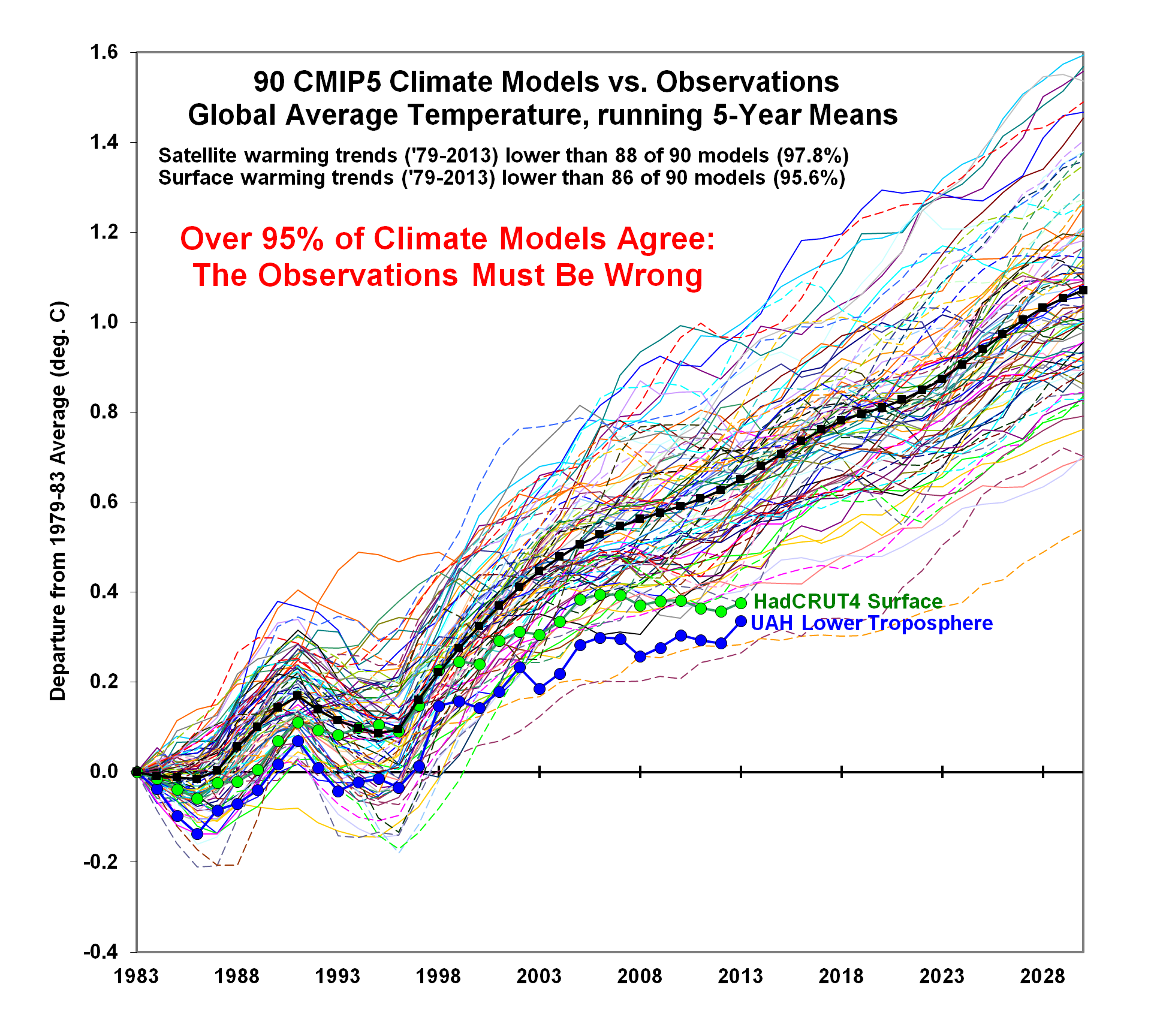
The actual data are the blue and green dots. The black dots are an average of the climate model predictions. The actual data shows about a 0.4C increase over the last 30 years, which extrapolates to about a 1.4C increase over a century.
According to this chart of actual satellite and
surface temperature observations vs. what was predicted by 90 different
climate models, 95 percent of models overestimated actual temperatures.
So when you hear the, “95 percent of scientists believe in global warming”
talking point, you can now reply with “95 percent of reality thinks your climate
models are garbage." (Credit to Sean Davis for this creative reply).
And therein lies the real reason why so many global warming alarmists
are so desperate to change the terms of the debate. Rather than discuss
the actual science, they’d rather marginalize anyone who disagrees with
their policy prescriptions.
The global warming alarmists aren’t attempting to shut down debate
because they’re worried the dissenters are wrong; the alarmists are
attempting to shut down debate because they know their models are wrong,
and they’d rather nobody focus on that inconvenient little fact.
What should we tell the plants?
Tell them that our scientists at the United States Environmental Protection Agency (the EPA) have declared that carbon dioxide is a pollutant. Tell the plants that the EPA must have forgotten what they learned in 9th grade biology about the Oxygen Cycle and how plants absorb CO2 and give off oxygen, which animals tend to breathe in on occasion.
What should we do now?
Don't give in to any of the 'carbon tax' proposals. And don't lose sleep over your 'carbon footprint'.
But go ahead and support cost-effective conservation efforts, and support the reduction of real pollutants such as mercury and lead.
______________________________________
Tim Farage is a Senior Lecturer in the Computer Science Department at The University of Texas at Dallas. The views expressed herein are those of the author. You are welcome to comment upon this blog entry and/or to contact him at tfarage@hotmail.com.
______________________________________
Thursday, March 22, 2012
The Top Five Lies and Half-Truths Found in Movies
Movies help to define
and influence our culture. But
movies frequently reflect lies and half-truths about what is good and
what is bad for humanity,
and many do so in such a manner as to degrade our culture.
1)
Myth: Nuclear power is dangerous and
has caused untold harm to us and the Earth. Radioactivity has
caused an untold number of mutations to humans, and to plants and animals.
Many movie monsters are the result of mutations due to radioactivity.
The Reality: Nuclear power provides
the safest, least- polluting, baseload of energy that mankind has
even known. Not a single American has died as a result of radiation
from a commercial nuclear power plant. And this includes Americans on
nuclear-powered aircraft carriers and submarines. This level of safety
is unheard of in the history of humanity.
Another major advantage of using nuclear power is
that we would no longer need to depend on countries hostile to us. For
instance, the most likely nuclear fuel in the future will be Thorium, which
the U.S. has plenty of. Some are estimating that we have over a
million years of nuclear fuel remaining.
Nuclear wastes? Not to worry. The new
reactor designs use the energy in current wastes to generate even more
energy, while eliminating most of the wastes. And when car batteries
become more efficient, we can charge them with electricity generated from a
nuclear-power plant, and eliminate autos as a source of pollution.
What about the nuclear-reactor problems in Japan?
Well, Japan had a (1-in-every-400-year) 9.0 earthquake, resulting in
devastating tsunamis, which killed well over 20,000 people. Some of
their 40-year-old nuclear reactors were severely damaged, and released some
radiation. Of the 20,000 people killed, how many were reportedly
killed by radiation? If you've read the hundreds of hysterical
articles about the damaged nuclear reactors, you'd think the answer would be
thousands. But as of 2012, the answer is -- you guessed it -- 0.
Would you like to scare 95% of the American
population? Use the work "nuclear" in a sentence.
There is a source of radiation that kills
thousands every year -- the Sun. These are mostly deaths due to skin
cancer. We must do something about that pesky Sun. We
do need about 10-15 minutes of sunlight a day to get our vitamin D.
But if you want to minimize your chances of getting skin cancer, after your
few minutes in the Sun, head to a nuclear power plant. If they let you
in, you'll be safe from any radiation there.
2) Myth: Businesses
are bad. They destroy the environment, they make the rich richer and
the poor poorer. Businessmen are unscrupulous and only care about how
much money they make, and how to increase the value of their stock.
The Reality: Sure, some businesses
and some businessmen are bad, but this can be said about any group and about
many individuals and is
just a reflection of the fact that we humans are flawed. But because
we allow free-enterprise more than most countries, we have provided an
environment in which our best people created the best products in the world,
because they can profit from this. Americans created electric
lighting, the telephone, cell phones, computers, affordable cars, the
Internet, GPS, YouTube, the polio vaccine and other wonder drugs, indoor
plumbing, IBM, Google, Intel, and thousands of businesses whose products
have made each of our lives better. Without privately-owned
businesses, we'd be about as prosperous as Cuba and North Korea. And
remember how well the Soviet Union worked out.
3) Myth: We are
destroying the Earth. Humans are responsible for most of the pollution
and global warming that are causing this destruction.
The Reality: There is nothing humans
can do to destroy the Earth. The huge asteroid that killed off the
dinosaurs and many other species around 65 million years ago did more harm
than we could possibly do. The Earth could not have cared less. And yet many paleo-biologists believe that
the death of the dinosaurs allowed mammals to flourish, eventually
allowing Homo sapiens to flourish.
Surely we would all like to create less pollution, to
grow more organic foods, to
conserve more, etc. And other entries in this blog tell how we can do
this. But none of what we're doing is "destroying the Earth."
Furthermore, prosperous countries tend to be the
least- polluted ones, because they can afford pollution controls. How
many movies that seem to be concerned about pollution point that fact out?
Instead, prosperous countries and prosperous people are ridiculed and called
greedy. Want a cleaner Earth? Do what it takes to be more
prosperous.
As one of many movie examples, in the latest remake of
The Day the Earth Stood
Still, the main alien, played by Keanu Reeves, said the humans must be
wiped out because there are not that many habitable planets in the galaxy
and his galactic alliance couldn't allow humans to destroy the Earth.
Keanu didn't
explain how humans were destroying the Earth. This was fortunate,
because his explanation would have been nonsensical. Presumably, it was
related to human pollution and human-caused global warming. Such
things could kill some humans and some species, but would not come close to
"destroying the Earth."
I can't imagine what his galactic alliance
was thinking, or, more to the point, what the movie's writers were thinking.
Couldn't this galactic alliance have shown us a way to generate inexpensive,
non-polluting energy? Instead, they
decided to destroy the entire human race, just so some other alien race
might use the "clean" Earth in the future. (Keanu Reeves did relent
and stop the genocide of the human race, but that did not change the premise
of the movie). There is so much nonsense here, one could make another movie
about the irrationality of this movie. For instance, suppose that
humans did stop polluting (or whatever was bothering Keanu)? This would
do the aliens no good at all, since humans would still be occupying the Earth, and
not the aliens. So really, if the aliens value the Earth so much, the
rational thing to do would be to destroy us before we can defend
ourselves. Of course, they would accumulate some very bad
karma doing this, but what the heck?
We'd be much better off
with a galactic alliance headed by Darth Vader.
How can a movie that makes those who intended the
genocide of humanity seem like the good guys? Only a movie made by
those who value snails and whales more than humans.
4) Myth: The rich
are bad. They are greedy. They take away jobs from the rest of us, have a
huge "carbon footprint", and will certainly not get into Heaven.
The Reality: Name a country with
very few rich, and you've just named a country where almost everyone is
poor. Most people who are rich earned their money by starting a
business (as opposed to inheriting their money). These businesses
create millions of jobs that create prosperity for the rest of us.
Microsoft, Intel, Facebook, and Google are just a few of the companies
started by individuals who are now rich. We should be happy for them,
and thankful that we live in a country that protects people's right to start
and profit from a business. Countries that don't protect such freedoms
are now mostly former countries, such as the Soviet Union and its
satellites. Those countries still around that don't protect such
freedoms will soon be former countries themselves, unless they start to
change and allow their citizens to be free to live in peace.
Of course there are rich individuals who do bad
things. For instance, someone who becomes rich but does not pay his
employees their fair share of what they have produced is going to get some
bad karma. Not as much as the aliens who destroy all of the intelligent life
on a planet, but bad karma nonetheless.
Movies that show disrespect to "the rich" help to
create class envy. And nothing good comes from envy. It harms a
person physically, mentally and spiritually. And it even makes them
less likely to become prosperous, because an envious person can blame the
rich for their woes, rather than take responsibility for their life.
And it allows our politicians to play "the-rich-are-bad-and-are- responsible-for-your-misery" game. Instead, our politicians should be telling us
what they would do to help increase the prosperity for all good Americans
who are willing to work.
5) Myth: There are
few religious people in the United States. Few mention God, few
pray, and many make fun of those who are religious.
The Reality: Recent polls have shown
that about 80-85% of Americans believe in God. But check out almost any
movie you can think of. Rarely is God even mentioned, and even more
rarely is someone shown praying. An alien who tried to deduce what
humans believed just from movies would deduce that most of us were
atheists, and and that those who were religious were irrational.
The disparaging of those who are religious is a very
dangerous trend. A country that is not predominantly religious will
eventually get into trouble. The biggest mass murderers in history,
such as Stalin,
(former
president of the U.S.S.R.), Pol Pot (former president of Viet Nam), Mao
(former chairman of China), Hitler (former dictator of Germany), and Tojo
(former emperor of Japan), were not in the least concerned with how God felt
about what they did.
And if God is not the source of one's morality, then
usually one looks to government for guidance and to solve one's problems.
And it's abundantly clear how well that works.
The founding document of our country, the Declaration
of Independence, states that our rights come from our Creator. If one
doesn't believe in a Creator, then our rights are up for grabs. No
thanks.
Conclusion:
Many movies get released that have some major
inaccuracy that contributes to our country's debasement or lack of knowledge. And yet movies, like most other things, can be used
to uplift or to degrade. There are many good movies out there that
leave one with a desire to make things better, that cause one's soul to
soar. We can
only aspire to creating a culture in which these will dominate the industry.
______________________________________
Tim Farage is a Senior Lecturer in the Computer
Science Department at The University of Texas
at Dallas. You are welcome to comment upon this blog entry and/or to
contact him at
tfarage@hotmail.com.
______________________________________
Subscribe to:
Posts (Atom)
Global Warming Update 2025
Climate scientists have found that global temperatures have likely risen by 1.5 °C since the Industrial Revolution. So what? You’ll find tha...
-
Someone tell me if I’m doing the math wrong. In the 12/3/2009 business section of the Dallas Morning News, there’s an article about a Whit...
-
 Int roduction This is first part of a series of posts about intelligent design (ID). I ntelligent design has been vilified by some...
 -
Climate scientists have found that global temperatures have likely risen by 1.5 °C since the Industrial Revolution. So what? You’ll find tha...
